There was a time when a business card was simply a piece of paper exchanged during a meeting.
Today, a digital business card is far more than contact information. It represents identity, reputation, relationships, and in many cases, direct access to a person’s professional world.
As founders building S͛Card, a security-focused digital business card platform, we spend a great deal of time thinking about trust, privacy, and how people interact online.
One question has become increasingly important in recent years:
Should professional identity platforms allow completely anonymous access?
For us, the answer is becoming clearer.
Not because we are against privacy.
In fact, quite the opposite.
We believe strongly in protecting the privacy and digital assets of our users. We believe professionals deserve control over their information, their identity, and who accesses their digital presence.
However, there is an important distinction that modern internet platforms can no longer ignore.
Protecting your own privacy is not the same as concealing your identity while accessing someone else’s professional identity.
That distinction matters.
A Digital Business Card Is No Longer Just a Contact Page
Most people still think of digital business cards as simple profile pages.
In reality, modern digital identity platforms contain significantly more information than traditional business cards ever did.
A professional profile today may include:
-
Contact details
-
Social media links
-
Company information
-
Professional relationships
-
Calendars or booking access
-
Communication channels
-
Brand identity
-
Business history
For many professionals, their digital business card has become an extension of their office.
And naturally, people expect offices to have security.
If someone walked into your office wearing a mask, refusing to identify themselves while attempting to inspect your files or gather information about your business, most people would immediately recognise that behaviour as suspicious.
Yet online, many platforms have normalised anonymous access as if there is no risk attached to it.
We believe that assumption is becoming outdated.
The Internet Has Changed
Over the past few years, the internet has quietly shifted from being primarily human-driven to increasingly machine-driven.
Most ordinary users do not see this change directly because much of it happens behind the scenes.
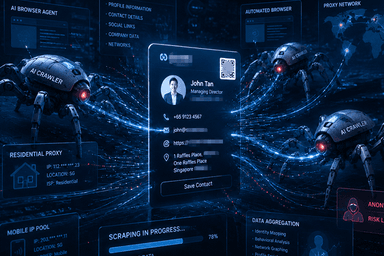
What appears to be a normal profile visit on the surface may actually involve automated systems, rotating proxy infrastructure, behavioural emulation tools, or AI-assisted scraping mechanisms operating at scale.
This is one of the biggest reasons why platforms responsible for digital identity can no longer approach security the same way they did a decade ago.
When digital business cards first became popular, the assumption was relatively straightforward:
Someone visits your profile because they genuinely want to connect.
Today, that assumption is no longer always safe.
Some visitors are genuine professionals.
Some are recruiters.
Some are potential clients.
Some are business partners.
But increasingly, some visitors are systems.
Not people.
And those systems are becoming significantly more sophisticated.
The internet economy around anonymous traffic has grown rapidly.
Entire industries now exist around providing anonymity infrastructure, scraping networks, rotating identities, proxy routing, and traffic obfuscation services.
Some of these tools are marketed as privacy tools.
Others are openly marketed for automation, growth hacking, scraping, intelligence gathering, or bypassing platform restrictions.
This evolution has fundamentally changed how security-focused platforms need to think.
The challenge today is no longer simply blocking obvious attacks.
The challenge is identifying intent.
That is considerably harder.
Especially when modern anonymous infrastructure is specifically designed to imitate legitimate human behaviour.
Anonymous traffic is no longer limited to individuals casually browsing online.
Modern internet infrastructure has evolved rapidly.
Today, anonymous access may involve:
The internet today is very different from what it was ten years ago.
Anonymous traffic is no longer limited to individuals casually browsing online.
Modern internet infrastructure has evolved rapidly.
Today, anonymous access may involve:
-
VPN networks
-
Datacentre IP addresses
-
Residential proxy farms
-
Mobile proxy networks
-
Automated browsing systems
-
AI-assisted scraping tools
-
Rotating identity systems
Some of these technologies have legitimate uses.
People use VPNs while travelling. Companies use secure routing systems for cybersecurity. Some individuals simply value personal privacy online.
That is entirely understandable.
But there is another side to this reality.
The same infrastructure is increasingly used for:
-
Automated scraping
-
Credential harvesting
-
Spam campaigns
-
Reconnaissance activity
-
Data collection
-
Identity mapping
-
Impersonation attempts
-
Large-scale automated crawling
As operators of a digital identity platform, we cannot ignore how these systems are being used.
The modern internet is no longer built entirely around human interaction.
Not every profile visitor is genuinely trying to connect.
Privacy Should Protect Ownership — Not Conceal Access
This is perhaps the most important point.
S͛Card is not anti-privacy.
We are serious about privacy.
Our responsibility is to protect the people using our platform.
That includes protecting:
-
Their professional identity
-
Their contact information
-
Their relationships
-
Their digital presence
-
Their business assets
Privacy matters when you are protecting what belongs to you.
However, the conversation changes when someone is attempting to access another person’s professional identity while simultaneously concealing who they are.
There is a meaningful difference between:
-
Protecting your own privacy online
and
-
Hiding your identity while accessing someone else’s digital space
That distinction is important.
A digital business card is not a public park.
It is part of someone’s professional identity.
If someone genuinely wants to connect professionally, some level of transparency and accountability should not be considered unreasonable.
Professional networking should begin with trust, not concealment.
The Rise of Non-Human Traffic
One of the biggest misconceptions about online traffic is the assumption that every visitor is a real person behaving normally.
That is no longer the reality.
A growing amount of internet traffic today is automated.
Some systems are designed to:
-
Scrape profile data
-
Collect contact information
-
Scan platforms at scale
-
Build databases
-
Map relationships between individuals
-
Train automated systems
-
Identify targets for phishing or impersonation
What makes the problem more difficult is that modern attack infrastructure has become increasingly sophisticated.
Residential proxy farms and mobile proxy networks are specifically designed to imitate legitimate human behaviour.
Instead of using obvious datacentre servers, these systems route traffic through real household or mobile internet connections, making them significantly harder to identify.
In many cases, the goal is not immediate damage.
The goal is observation.
Learning patterns.
Understanding how systems respond.
Studying defences.
Attackers today continuously adapt their behaviour based on what platforms detect and what platforms ignore.
This is why modern security cannot remain static.
Why Security Platforms Must Continuously Evolve
One of the biggest misconceptions in technology is the idea that security can be solved once and remain solved forever.
In reality, security is a continuous process.
Every improvement in technology creates both opportunity and risk.
As platforms become smarter, attackers become smarter.
As security systems improve, anonymous infrastructure evolves alongside them.
As AI becomes more capable, automated abuse becomes more scalable.
This is the environment modern digital identity platforms now operate in.
At S͛Card, we constantly observe how anonymous traffic patterns evolve over time.
What worked for attackers six months ago may no longer work today.
And what works today may evolve again tomorrow.
This is why security-focused platforms cannot remain static.
They must continuously learn.
Continuously adapt.
Continuously improve.
Because attackers themselves continuously study platforms.
They analyse behavioural patterns.
They monitor detection systems.
They test platform responses.
They identify weaknesses.
In many cases, anonymous systems are not simply trying to access a profile once.
They are learning how a platform behaves.
This is particularly true with modern residential proxy farms and mobile proxy infrastructure.
Unlike traditional datacentre traffic, these systems are designed to appear more human.
Traffic may rotate between real residential internet connections.
It may mimic normal browsing patterns.
It may intentionally slow down activity to avoid detection.
Some systems even simulate cursor movement, browsing pauses, or engagement behaviour.
The objective is simple.
Blend into legitimate traffic.
And this is exactly why modern security requires ongoing investment and ongoing evolution.
One of the realities of operating a digital platform today is understanding that threats evolve continuously.
Technology moves forward.
Attackers evolve.
Automation improves.
AI systems become more capable.
Anonymous infrastructure becomes cheaper and more accessible.
Security platforms therefore cannot rely on outdated assumptions.
At S͛Card, we believe protecting users requires continuous improvement.
That means continuously investing in:
-
Behavioural monitoring
-
Suspicious traffic detection
-
Anti-scraping systems
-
Adaptive protection methods
-
Infrastructure intelligence
-
Security updates
-
Threat analysis
-
Pattern recognition
-
Platform hardening
Digital security is not something you install once and forget.
It is an ongoing responsibility.
This is also why we believe modern security-focused SaaS platforms must continuously evolve.
Technology does not stand still.
Threats do not stand still.
And platforms responsible for protecting professional identities should not stand still either.
There is also a broader misconception in the digital product industry that deserves discussion.
Many people still approach software as if it were a static physical product.
Buy once.
Use forever.
But security infrastructure does not work that way anymore.
A security-focused platform operating in today’s internet environment requires:
-
Continuous monitoring
-
Ongoing infrastructure upgrades
-
Detection model improvements
-
Threat intelligence
-
Abuse prevention systems
-
Engineering adaptation
-
AI-assisted analysis
-
Constant maintenance
The internet is evolving every single day.
And platforms that stop evolving eventually become vulnerable.
In cybersecurity, standing still is effectively moving backwards.
One of the realities of operating a digital platform today is understanding that threats evolve continuously.
Technology moves forward.
Attackers evolve.
Automation improves.
AI systems become more capable.
Anonymous infrastructure becomes cheaper and more accessible.
Security platforms therefore cannot rely on outdated assumptions.
At S͛Card, we believe protecting users requires continuous improvement.
That means continuously investing in:
-
Behavioural monitoring
-
Suspicious traffic detection
-
Anti-scraping systems
-
Adaptive protection methods
-
Infrastructure intelligence
-
Security updates
Digital security is not something you install once and forget.
It is an ongoing responsibility.
This is also why we believe modern security-focused SaaS platforms must continuously evolve.
Technology does not stand still.
Threats do not stand still.
And platforms responsible for protecting professional identities should not stand still either.
Why S͛Card Takes a Different Approach
At its core, S͛Card was built around a simple belief:
Professional networking should feel safe.
People should be able to share their identity online without feeling exposed to invisible systems designed to exploit that information.
That does not mean eliminating privacy.
It means balancing privacy with accountability.
It means recognising that professional identity platforms are fundamentally different from anonymous public forums.
It means understanding that trust matters.
When we detect suspicious traffic patterns, anonymous infrastructure, or non-human behaviour, our responsibility is not to protect the anonymity of the incoming system.
Our responsibility is to protect the user.
That principle shapes how we think about platform security.
And increasingly, we believe more digital identity platforms will need to adopt the same mindset.
The Future of Digital Networking Will Be Built on Trust
The internet spent years learning how to protect users’ data.
The next challenge is learning how to protect users from anonymous systems designed to exploit that data.
As digital identity becomes more valuable, professional platforms will inevitably become more security-conscious.
Trust, accountability, and identity verification will become increasingly important parts of professional networking.
At S͛Card, we believe that is the direction the internet is moving towards.
Not because privacy is wrong.
But because professional relationships cannot thrive in environments built entirely around anonymity and invisible access.
A secure digital business card should open opportunities.
Not expose people to risks they cannot see.
And ultimately, trust cannot exist where accountability completely disappears.