A few years ago, most online interactions felt relatively straightforward. Someone received your profile link, opened it, viewed your details, perhaps saved your contact information, and moved on. The behaviour looked human because, most of the time, it genuinely was human.
Today, the environment looks very different.
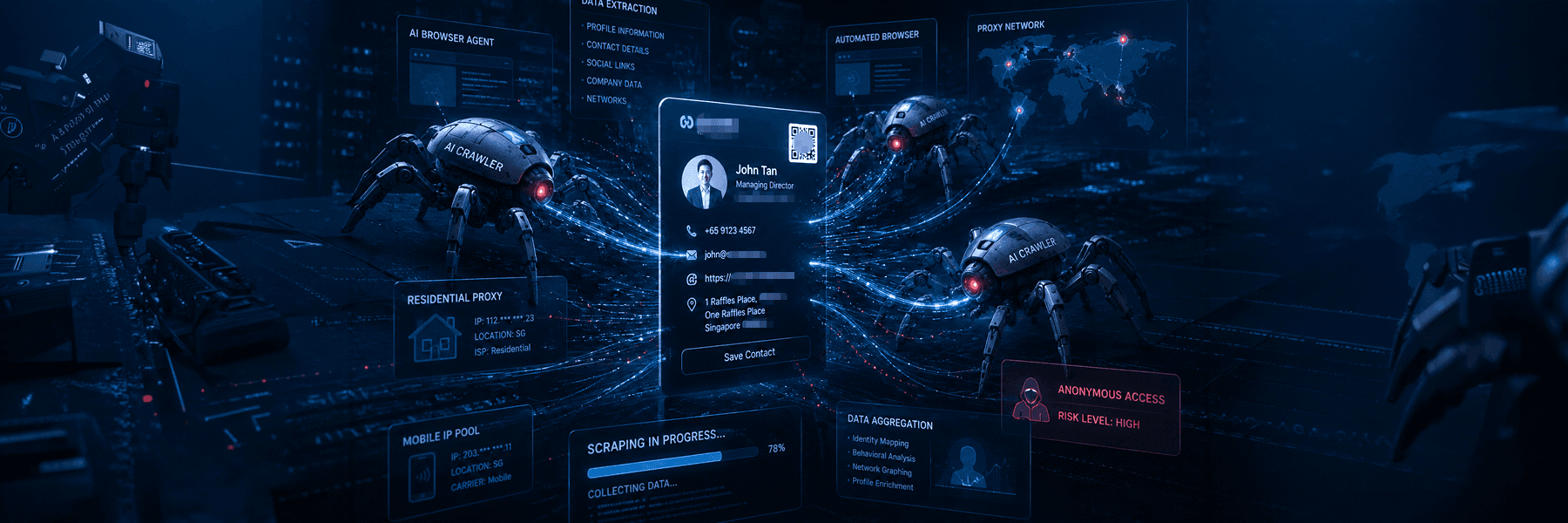
As operators of a digital identity platform, we increasingly observe traffic routed through VPNs, datacentre infrastructure, residential proxy networks, mobile IP farms, automated crawling systems, and AI-assisted browser agents. Some visitors are legitimate users protecting their privacy. Others are automated systems collecting information at scale. Some are not even traditional users in the normal sense anymore.
The internet has evolved rapidly, and so has the infrastructure behind anonymous digital activity.
This shift matters because digital business cards are no longer simple contact pages. They have become extensions of professional identity. They contain relationships, communication channels, social presence, business affiliations, and behavioural signals. In many ways, a digital profile now represents a layer of a person’s professional existence.
That makes it valuable.
And wherever value exists online, organised abuse eventually follows.
At s͛Card, this reality has fundamentally shaped how we think about security, identity, and trust-based networking.
Digital Profiles Have Become Valuable Targets
Professional identity platforms contain far more information than many people realise.
A modern digital business card may include:
- contact details,
- social media accounts,
- company affiliations,
- communication links,
- portfolio access,
- networking relationships,
- behavioural interaction patterns.
Individually, these details may appear harmless. Combined together, they become extremely valuable.
For legitimate users, this creates convenience and stronger professional networking. For malicious operators, the same information can support phishing campaigns, impersonation attempts, spam operations, social engineering, reconnaissance, and data aggregation.
This is one of the reasons digital identity platforms are increasingly attracting automated traffic.
The misconception many people still hold is that attackers only target banks, governments, or major corporations. In reality, identity itself has become one of the most valuable assets on the modern internet.
Professional profiles provide context.
Context creates targeting opportunities.
At scale, aggregated profile data becomes even more powerful.
This is where modern scraping infrastructure enters the picture.
VPNs Are Only One Part Of A Much Larger Ecosystem
Conversations around anonymous internet traffic often become overly simplistic.
Not every VPN user is malicious.
Many people use VPNs for entirely legitimate reasons:
- protecting privacy on public Wi-Fi,
- travelling internationally,
- securing remote work connections,
- avoiding insecure networks,
- maintaining personal anonymity online.
Privacy itself is not the issue.
However, the same infrastructure that protects privacy can also be used to conceal intent.
That distinction matters.
The challenge facing modern digital platforms is not merely the existence of VPNs. The challenge is that anonymous infrastructure has become deeply integrated into large-scale automated activity.
Today’s ecosystem includes:
- datacentre proxies,
- residential proxy networks,
- mobile IP farms,
- rotating proxy systems,
- browser automation frameworks,
- AI-assisted crawling systems,
- distributed scraping infrastructure.
Modern malicious activity rarely resembles the stereotypical image of a lone hacker manually attempting to break into systems. Increasingly, abuse operations are automated, scalable, distributed, and designed to blend into normal internet behaviour.
The goal is often not aggression.
The goal is invisibility.
The Rise Of Residential And Mobile IP Farms
One of the biggest changes in cybersecurity over recent years has been the growing use of residential and mobile proxy infrastructure.
Traditional security systems were originally designed to detect suspicious traffic originating from datacentres or obvious server infrastructure. Datacentre traffic often carries identifiable characteristics because it originates from cloud servers rather than ordinary consumer internet connections.
As defensive systems improved, attackers adapted.
Residential proxy networks emerged as a way to make automated activity appear legitimate.
In simple terms, residential proxy infrastructure routes traffic through real household internet connections. From the outside, the traffic may appear to originate from an ordinary person browsing from home.
That creates an entirely different security challenge.
A system attempting to identify malicious automation can no longer rely purely on obvious server indicators. The traffic may look remarkably normal.
Large commercial proxy providers openly market residential infrastructure capable of operating at massive scale. Some platforms advertise hundreds of millions of residential IPs globally, designed specifically for web data extraction, automation, and AI agent access.
Mobile IP farms create another layer of complexity.
These systems route traffic through mobile carrier networks while frequently rotating identities. Because mobile traffic naturally shifts across networks and locations, distinguishing genuine users from automated behaviour becomes significantly harder.
This matters because modern attacks increasingly focus on imitation rather than force.
The modern attacker often prefers invisibility over aggression.
At scale, these infrastructures can support:
- automated scraping,
- behavioural mapping,
- reconnaissance,
- profile enumeration,
- identity harvesting,
- spam operations,
- targeted phishing preparation.
What makes the situation more complicated is accessibility.
Infrastructure that once required specialised expertise is now commercially available. Proxy services, rotating residential traffic, browser automation frameworks, and mobile routing systems can often be rented cheaply and deployed at scale.
The barrier to entry has dropped dramatically.
Not Every Profile Visitor Is Human Anymore
This is perhaps one of the most important realities modern platforms must now accept.
Not every visitor is a genuine person manually browsing a profile.
Some traffic is generated by:
- scraping bots,
- AI-assisted crawlers,
- automated browser agents,
- behavioural mapping systems,
- reconnaissance tools,
- data aggregation engines.
This is no longer theoretical.
AI browser agents capable of autonomously interacting with websites are becoming increasingly mainstream. Systems such as OpenAI Operator, autonomous browser frameworks, and agentic web technologies are designed to navigate websites, complete actions, collect information, and interact with online environments with growing sophistication.
Industry discussions around “stealth AI browser agents” now openly focus on anti-detection methods, identity management, browser automation infrastructure, and techniques for imitating human browsing behaviour.
The line between automated systems and human browsing behaviour is becoming increasingly blurred.
This does not mean every unusual visitor is malicious. Security platforms should avoid simplistic assumptions based solely on geography or infrastructure type.
The real challenge lies in understanding behaviour.
There is a meaningful difference between:
- a human manually viewing a profile,
- and an automated system harvesting thousands of them.
Modern platforms increasingly need to analyse behavioural signals rather than relying purely on static assumptions.
Examples may include:
- abnormal request frequency,
- rapid sequential profile visits,
- automated navigation timing,
- infrastructure rotation patterns,
- large-scale enumeration behaviour,
- non-human interaction sequences.
A genuine professional connection behaves differently from industrial-scale scraping infrastructure.
That distinction matters.
The Security Landscape Is Becoming Increasingly Complex
One of the biggest misconceptions about cybersecurity is the belief that threats remain relatively static.
They do not.
The internet today operates on an entirely different playing field compared to even a few years ago.
Several major shifts have accelerated this transformation:
- advances in AI systems,
- autonomous browser agents,
- open-source crawling frameworks,
- cheaper cloud infrastructure,
- scalable GPU compute,
- low-cost distributed proxy infrastructure,
- increasingly powerful consumer hardware.
Collectively, these developments have transformed the scale and sophistication of online automation.
What once required highly specialised technical capability can now often be executed with significantly lower barriers.
Modern AI agent systems are increasingly capable of interacting with websites autonomously, analysing page structures, adapting workflows dynamically, and performing browser-based tasks previously associated only with human users.
Research discussions around AI browser agents now openly address stealth browsing, anti-detection infrastructure, identity simulation, and scalable browser fleets.
At the same time, the infrastructure supporting large-scale automation has become cheaper and more accessible.
Cloud computing has lowered infrastructure costs.
GPU hardware has accelerated processing capability.
Distributed systems allow massive concurrency.
Residential and mobile proxy infrastructure enables large-scale identity rotation.
A single operator today can command a level of automation and scale that would have required organised teams several years ago.
This changes the economics of abuse entirely.
The challenge for modern platforms is no longer simply blocking obvious attacks. The challenge is distinguishing genuine human interaction from increasingly sophisticated systems specifically designed to appear human.
That requires a very different security mindset.
Attackers Learn Too
One of the realities of operating a modern digital platform is understanding that malicious systems evolve continuously.
Security is not static because attackers are not static.
Modern automated systems increasingly observe:
- defensive patterns,
- platform behaviour,
- rate limits,
- detection responses,
- interaction timing,
- access restrictions.
In many ways, suspicious traffic itself becomes a source of intelligence.
Every interaction teaches something.
Over time, automated systems evolve around defensive behaviour. They adjust timing patterns, rotate identities, modify navigation behaviour, distribute requests more intelligently, and increasingly imitate natural user activity.
Research into AI agents now highlights growing concerns around attribution, indirect prompt injection, behavioural manipulation, and autonomous system abuse.
This creates a constant learning cycle between platforms and automated systems.
That is one reason simplistic security thinking no longer works effectively.
The conversation can no longer revolve around whether a single VPN user should automatically be trusted or blocked. Modern security requires behavioural understanding, contextual analysis, and adaptive risk evaluation.
At s͛Card, we increasingly view platform security as an ongoing process of learning and adaptation rather than a fixed defensive state.
Patterns evolve constantly.
Infrastructure changes constantly.
Automation improves constantly.
The internet itself is becoming increasingly dynamic.
Why Security Can No Longer Be Static
This evolving landscape also changes how digital security products must operate.
There is a growing misconception within parts of the software industry that digital platforms can be treated as static products. In reality, modern security environments evolve continuously.
Threat infrastructure evolves.
Automation evolves.
AI systems evolve.
Traffic patterns evolve.
Proxy ecosystems evolve.
Security must evolve as well.
This is one of the reasons we believe modern identity and networking platforms require continuous operational investment rather than static protection models.
Maintaining secure digital infrastructure today involves:
- behavioural analysis,
- ongoing monitoring,
- infrastructure adaptation,
- defensive refinement,
- continuous engineering work,
- evolving detection systems.
Security is not a feature that gets completed once.
It is an ongoing operational commitment.
This distinction becomes increasingly important as attack infrastructure becomes cheaper, more accessible, and more intelligent.
In rapidly evolving environments, static software models struggle to keep pace with changing threats. Platforms that stop adapting eventually become predictable.
Predictability creates vulnerability.
Most users understandably interact with digital products based on convenience and functionality. Yet behind every secure platform exists a continuous operational effort to adapt to changing internet behaviour.
That work never really stops.
Why We Built s͛Card With A Security-First Perspective
At s͛Card, our approach to security is shaped directly by the realities we observe operating a digital identity platform.
We do not believe professional networking should operate entirely without accountability.
At the same time, we do not believe all anonymous traffic should automatically be treated as malicious. That would be an overly simplistic position.
Instead, we believe modern platforms must evaluate risk signals intelligently and contextually.
This includes:
- suspicious behavioural patterns,
- abnormal automation signals,
- infrastructure anomalies,
- non-human interaction patterns,
- scraping behaviour,
- large-scale anonymous access attempts.
The objective is not to eliminate privacy.
The objective is to preserve trust.
Professional identity platforms exist to facilitate genuine human relationships, meaningful connections, and legitimate interaction. As anonymous infrastructure becomes increasingly industrialised, preserving that trust becomes increasingly important.
Digital networking platforms are now balancing two competing realities:
- openness,
- and protection.
That balance becomes harder every year.
The Future Of Digital Networking Will Depend On Trust
The internet is entering a period where identity, trust, automation, and security are becoming deeply interconnected.
Anonymous infrastructure will continue evolving.
AI-assisted automation will continue advancing.
Distributed proxy ecosystems will continue growing.
Hardware capability will continue scaling.
None of this is slowing down.
Recent industry discussions increasingly acknowledge that AI agents are beginning to challenge traditional assumptions around web traffic, identity, and online interaction.
As these systems become more sophisticated, digital platforms will increasingly need to distinguish between:
- genuine interaction,
- and industrial-scale anonymous activity.
That challenge will shape the future of digital networking.
The platforms that succeed long term will likely not be the ones that remain completely open without safeguards, nor the ones that become excessively restrictive. The future will belong to platforms capable of balancing accessibility with accountability.
Professional networking was never meant to become invisible mass surveillance conducted through automated infrastructure.
It was meant to facilitate human trust.
At s͛Card, we believe trust will become one of the most important foundations of digital identity in the years ahead.