Artificial intelligence has rapidly transformed from emerging technology to business-critical infrastructure. Today, a shrinking group of leaders — OpenAI, Anthropic, Microsoft, and Google—are not just racing to build models, but vying for influence over how enterprises, governments and entire industries adopt AI. Adding to the complexity: a rising wave of Chinese AI and semiconductor initiatives. For professionals, understanding these alliances, strategic shifts, and technological leaps is essential to allocate capital, choose partners, and forecast competitors.
The Rise of Anthropic and Its Alliance with Microsoft and Nvidia
A. Anthropic’s Emergence
Anthropic — founded by former OpenAI researchers — gained traction with its safety-focused approach and the Claude model family. Recently, the company secured major backing: a multi-billion-dollar commitment from Microsoft and Nvidia tied to roughly US$30 billion in cloud capacity via Azure, plus a US$15 billion investment. These moves elevate Anthropic into one of the top-funded frontier-AI labs globally.
B. Strategic Implications
For Microsoft, investing heavily in Anthropic diversifies its AI ecosystem beyond a sole dependence on OpenAI. It grants Microsoft flexibility to deploy the most suitable model—Claude, OpenAI’s GPT, or others—for different enterprise use cases. For Nvidia, the arrangement helps ensure sustained demand for GPU-driven compute, while Anthropic benefits from the cloud scale and financial firepower to compete for talent and push rapid R&D.
Microsoft’s Evolving Relationship with OpenAI
A. Historical Context
Microsoft’s original bet was simple: access to OpenAI’s cutting-edge models, powered by Azure, and integration of those models into Microsoft products like Copilot. For years, that exclusive relationship defined Microsoft’s AI strategy.
B. Recent Developments
That exclusivity is shifting. Microsoft has started integrating Anthropic’s models (Claude) into productivity offerings such as Microsoft 365 Copilot — a clear signal that it no longer views OpenAI as the only AI engine. At the same time, Microsoft retains its stake in OpenAI, maintaining a dual-track AI approach. This strategy hedges bets — giving Microsoft influence over multiple AI suppliers and the option to pivot depending on which model or lab delivers better performance or enterprise-fit.
Google’s New Momentum: Gemini 3, Nano Banana Pro, and Antigravity
A. Gemini 3 — A Strategic Leap Forward
With the launch of Gemini 3 (in the “Pro” tier), Google has reasserted itself in the frontier-model race. Gemini 3 offers truly multimodal capabilities—efficiently handling text, images, reasoning, coding, and more within a unified model. That versatility marks a qualitative shift, positioning Google not just as a competitor, but as a potential frontrunner for enterprises seeking a one-stop shop for AI tools. Analysts note that Gemini 3 represents “a turning point,” because Google has successfully leveraged scaling laws and multimodal integration to outclass many rivals.
B. Nano Banana Pro — Enterprise-Ready Visual Content at Scale
Complementing Gemini 3 is Nano Banana Pro, Google's upgraded AI-powered image generation and editing model built on Gemini 3 Pro. It delivers studio-quality visuals, accurate text rendering (even in multiple languages), and high resolution (2K/4K). It supports advanced controls — color grading, lighting adjustments, aspect-ratio flexibility — and can blend multiple images while maintaining subject consistency. For businesses, this means the ability to rapidly produce marketing visuals, product mock-ups, infographics, localised creatives, and more — at a fraction of the typical time and cost.
The launch of Nano Banana Pro is strategic: by combining multimodal intelligence (Gemini 3) with visual content generation, Google is offering an end-to-end creative and productivity platform, attractive to agencies, advertisers, designers, and enterprises producing visual content at scale.
C. Google Antigravity — Rethinking How Software Gets Built
Google Antigravity is a newly introduced “agent-first” IDE, leveraging Gemini 3 Pro, intended for real-world software development. In practical terms, companies can use Antigravity to delegate coding, testing, UI building, and even interface automation to AI agents. The platform supports multiple agents working in parallel, generating verifiable artefacts (code, logs, screenshots) rather than opaque “black-box” outputs.
For businesses, Antigravity introduces the possibility of dramatically accelerating development cycles, reducing engineering load, and cutting time-to-market — especially for prototyping, internal tools, data pipelines, or small-to-mid-scale products. It signals Google’s ambition to integrate AI not only into content and productivity workflows, but also deep into software development pipelines.
China’s Advancements in AI and Semiconductor Development
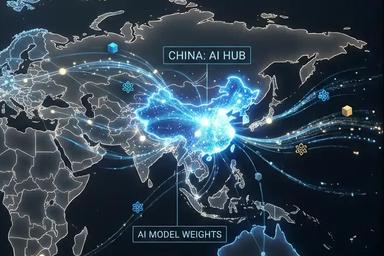
Despite the spotlight on Western labs, Chinese AI and hardware initiatives continue to rise. Chinese firms are investing heavily in AI-specialised semiconductors and domestically trained models, with the objective of long-term AI self-sufficiency. This push threatens to reshape global hardware supply chains and influence who controls the future of compute — a critical resource underpinning all large AI models.
This trend adds geopolitical and strategic complexity: Western companies depending on global supply chains may face pressure to diversify, while partners aiming for fault-tolerant supply might increasingly tap Chinese hardware providers.
Comparative Analysis: Strategic Alliances, Market Implications, and Competitive Advantage
A. OpenAI vs. Anthropic vs. Google
- OpenAI remains a heavyweight — but no longer unchallenged.
- Anthropic leverages strong financial backing and safety-first positioning to offer enterprises alternative models, pressuring OpenAI to maintain performance and alignment.
- Google, with Gemini 3 + Nano Banana Pro + Antigravity, is executing a vertically integrated strategy: a single ecosystem handling data ingestion, reasoning, image generation, software development — all under one roof. For enterprises seeking consolidation, this could be more efficient, coherent, and cost-effective than stitching together disparate providers.
In many ways, Google’s offering resembles a “full-stack AI platform,” from ideation to deployment — challenging the more modular, partnership-driven strategy of Microsoft (and by extension, OpenAI/Anthropic).
B. Microsoft vs. Google — Two Divergent Strategic Paths
- Microsoft emphasizes diversification and flexibility — relying on multiple AI labs (OpenAI, Anthropic) to hedge risk and select best-in-class models for each use case.
- Google bets on vertical integration and platform consolidation — embedding AI throughout its ecosystem (apps, creative tools, developer tools, advertising, cloud).
For enterprise buyers, the strategic difference is significant: Microsoft’s approach may offer best-of-breed flexibility; Google’s may offer lower friction, unified billing, and a one-vendor experience.
C. China — The Wild Card for Hardware & Scaling
China’s hardware and AI research push may undercut Western supply-chain dominance. If Chinese AI chips and models mature, global AI could bifurcate — Western-backed cloud/compute networks on one side, and Chinese domestic or export-oriented AI hardware ecosystems on the other. This could reshape partnerships, pricing, and even regulatory strategy for multinational enterprises.
Conclusion & Strategic Outlook for Business Leaders
A. Summary of Key Points
- Anthropic’s funding and cloud commitments position it as a serious challenger.
- Microsoft’s multi-partner strategy adds resilience and flexibility.
- Google has re-emerged strongly, with Gemini 3, Nano Banana Pro, and Antigravity forming a cohesive, full-stack AI platform
- China’s push introduces a potentially disruptive hardware supply-chain and competitive dynamic.
B. What Businesses Should Watch — and Do
- Evaluate consolidation vs. diversification: Depending on your needs, a unified stack (Google) or a modular, best-of-breed approach (Microsoft + Anthropic/OpenAI) might suit better.
- Anticipate cost and scale efficiencies: Tools like Nano Banana Pro and Antigravity dramatically reduce time and effort for content creation and software development — potential for real savings and faster time-to-market.
- Monitor geopolitical and supply-chain risks: The rise of Chinese AI hardware could impact pricing, availability, and global partnerships — relevant for firms with global footprint.
- Plan for hybrid AI adoption strategies: It may no longer be vendor lock-in or loyalty — but flexibility, agility, and adaptability become critical as multiple powerful AI ecosystems coexist.