You notice it first in small ways. Replies arrive faster than you expected. Forms that once took days are approved in minutes. Reports appear before meetings even start. Somewhere along the way, waiting quietly disappears from daily life.
Artificial intelligence is no longer optional, experimental, or confined to tech companies. It sits inside government portals, customer service chats, hiring systems, classrooms, hospitals, logistics networks and banks. Often invisible, quietly stitched into the mechanics of modern life.
At first, it feels like a gift. Fewer repetitive tasks. Faster answers. Smoother systems. A genuine productivity boost.
But productivity boosts rarely stay as bonuses. They harden into baselines. And baselines quietly turn into expectations.
The promise of AI is easy to sell: efficiency, growth, convenience. The cost is harder to quantify. Constant pressure. Less space to pause. Rising expectations of what a human should be able to process, deliver, and endure.
So the real question is not whether AI is powerful. It clearly is. The question is whether AI is lifting humanity forward, or slowly turning up the heat until we are all expected to operate at machine tempo.
AI as Progress: Why Acceleration Makes Sense
There are good reasons the world is embracing AI so quickly. The technology works. It can summarise information faster than teams can meet. It can spot patterns faster than managers can scan dashboards. It automates customer support, reduces fraud, optimises supply chains, personalises services and speeds up decision-making.
For governments, AI promises smoother public services and better use of resources. For companies, it means leaner operations and new products. For individuals, it offers shortcuts: drafting emails, translating documents, planning trips, designing visuals, learning new skills.
And then there is competition. In many industries, AI is no longer a nice extra. It is survival infrastructure. If your competitor delivers in one day, your three-day process becomes slow. If they reply in an hour, your next-day response feels careless. Efficiency stops being about excellence and becomes about staying relevant.
Some cities go further than adoption. They reorganise themselves around speed.
Singapore is often cited as a benchmark: streamlined services, coordinated systems, and a culture that values reliability and fast execution. Dubai is rapidly moving in a similar direction, driven by ambition, centralised decision-making, and a strong appetite for scalable systems.
In these environments, progress is measured by reduced friction. Fewer steps. Faster approvals. Quicker access. More automation. It is impressive. It is also revealing, because it shows what happens when speed becomes part of identity, not just a feature.
When Progress Turns Into Pressure
Speed rarely stays optional. A tool arrives as an advantage. Early adopters gain leverage. The market adjusts. What was once impressive becomes expected.
That is how optional speed becomes mandatory speed.
AI raises the baseline for output, responsiveness, and iteration. People are no longer competing only with other people. They are competing with people assisted by machines. The rhythm of work shifts away from human pacing, with its pauses and variability, towards system pacing, which is always available and always on.
The pressure does not usually come from a single manager or policy. It comes from the new normal.
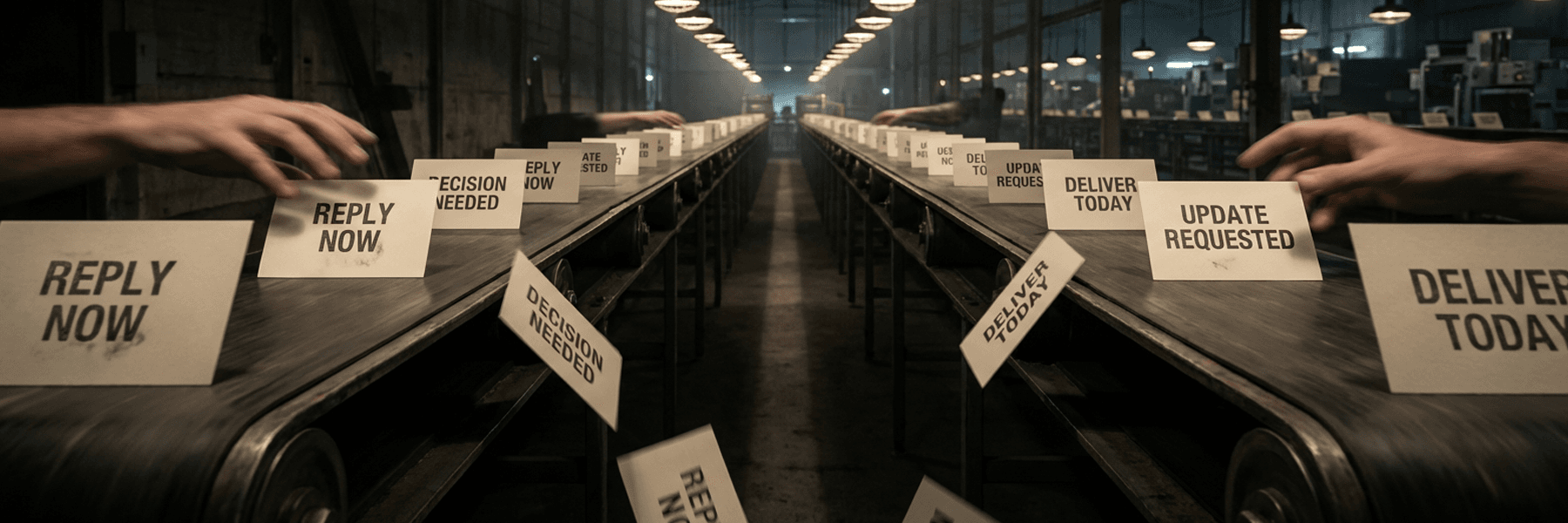
Much of today’s stress does not announce itself as stress. It appears as shorter response-time expectations. Always-on notifications. Casual urgency disguised as efficiency. Endless small deadlines that collectively erase deep work and recovery.
Because it is framed as productivity, not pressure, it becomes difficult to push back. The stress is baked into the system itself.
Dubai’s Acceleration and What It Reveals
Dubai’s AI push signals more than technological ambition. It signals identity. Large investments, government-backed initiatives, national strategies and task forces all point in the same direction. Speed equals leadership.
In a city that moves decisively, everyone inside it feels that movement. On the positive side, AI-enabled systems genuinely make life easier. Approvals are faster. Services are smarter. Business processes are smoother. That is real progress.
But those same improvements raise expectations across the ecosystem. If licensing is faster, businesses are expected to launch faster. If customer service becomes instant, patience disappears. If content generation becomes easy, output doubles. If analysis takes seconds, decisions must follow quickly and mistakes become less forgivable.
Acceleration spreads. It rarely stays contained.
The Myth of Easy AI
Part of the pressure comes from how AI is presented. The surface is polished. Clean dashboards. Friendly interfaces. Tools that appear to replace entire departments. Even coding now looks effortless, driven by prompts and confidence rather than depth.
This creates a seductive story. Anyone can plug in AI and move faster. Speed becomes proof of competence.
But beneath that surface lies complexity. Infrastructure. Data governance. Security. Compliance. Monitoring. Integration. Maintenance. None of it disappears just because the interface looks simple.
Speed-first adoption often creates fragile foundations. And fragile foundations do not fail quietly. More systems mean more attack surfaces. More integrations mean more points of failure. Automated decisions raise the stakes when something goes wrong.
The rush to move fast often skips understanding. The cost of that skipped understanding eventually arrives as breaches, unreliable outputs treated as truth, legal exposure, and systems that collapse under pressure. Rushing is not free. It simply delays the invoice.
The Human Trade-Off
AI can reduce the time it takes to complete tasks. What it rarely reduces is the amount of work expected. In many environments, time saved is quickly converted into more output.
You finish in two hours what once took six, and the reward is more tasks waiting.
Productivity rises, but presence declines. People become efficient but less available to themselves. Less unstructured thinking. Less rest. Fewer slow moments where creativity and meaning tend to emerge.
Work-life balance is often promoted through policies and perks, but lived reality tells a more complicated story. Long commutes eat into personal time. Rising costs push people to work harder. Schedules are optimised for efficiency rather than choice. Life becomes organised around convenience, discounts, and speed rather than rest and relationships.
Efficiency can quietly turn into a treadmill.
Living Inside the Pressure Cooker
Optimised systems are not tolerant of human variation. Humans need recovery. They need cycles. They need days where output is lower.
Fast systems demand fast humans, with less room for reflection, mistakes, or recalibration. When everything is measurable, being human can start to feel like underperformance. Mental fatigue becomes normalised, and once it is normalised, it stops being questioned.
Perhaps the sharpest pressure is fear of falling behind. People adopt AI not because they are ready, but because they are afraid. Teams deploy tools they barely understand. Leaders push automation before trust exists. Workers feel compelled to prove they can keep pace with machine-augmented expectations.
That is when the relationship flips. Humans start adapting to machines, rather than machines serving humans.
The Question Beneath the Technology
AI itself is neutral. Progress is necessary. The real danger is not innovation, but unexamined acceleration.
The deeper question is who controls the pace.
Who sets the tempo: humans or systems? Should everything that can be faster, be faster? What parts of life should remain deliberately slow: education, healthcare decisions, justice, relationships, creativity, recovery?
The challenge is not building smarter tools. It is building a culture wise enough to say that not everything needs to be instant, without being punished for it.
Progress With a Temperature Gauge
AI can expand human potential. It can reduce friction, unlock creativity, and create real value. But unchecked speed does not automatically create freedom. Sometimes it creates pressure that feels like progress until you realise you are struggling to breathe.
The goal is not to reject AI. It is to set boundaries around speed.
Progress should serve humanity, not cook it.
The future may depend on whether we treat AI as a tool, or as a thermostat we forgot to control.